What does Freedom Mean?
In the waning weeks of the Obama Presidency, the President signed into law three new National Monuments to preserve and interpret sites related to civil rights around the country. This visit turned out to be much more profound than I expected, and stories that still keep me tearing up, so here we go:
Of the three sites Obama created, two of the sites are located in Alabama (The Freedom Riders National Monument, and the Birmingham Civil Rights National Monument) and the third is in South Carolina and interprets the Reconstruction Era.
All three sites are works in progress, trying to construct visitor facilities and work with local partners to tell the story. I was in the midst of travel planning for the Martin Luther King Jr. holiday and found out that for the 1 year anniversary of the National Monument being designated, there would be events all day, and the visitor center would open briefly for the first time.
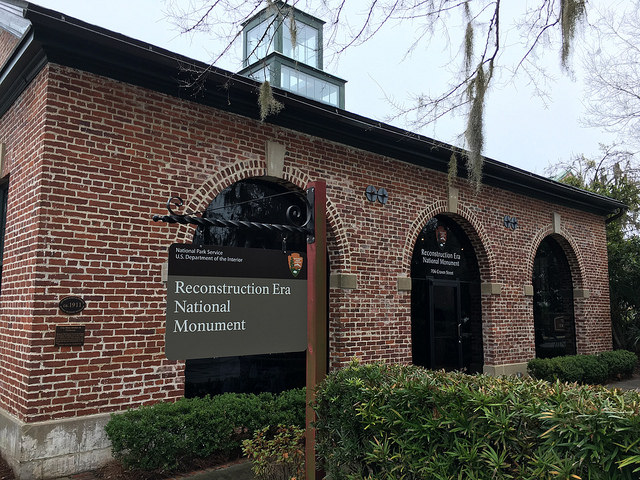
Open! One Day Only
The Reconstruction Era is arguably the most misunderstood, or least understood, time periods in American history. I remember learning it as Radical Republicans against President Andrew Johnson, and that it was largely seen as unsuccessful with the rise of Jim Crow and the KKK. I thought much more in concrete terms of literally rebuilding a broken South, but I didn’t see the stories of how an entire nation of people became Americans.
Why Beaufort, SC and what’s Reconstruction?
The idea that one site can encapsulate an era in the entire country seems like a tall order, but looking into what Beaufort offers, it’s clear, this is the place. As the Union troops advanced into South along the coast in 1861, plantation owners started to flee, but their slaves refused to leave with them. The Union Army was soon in control of the sea islands, and 10,000 slaves. Suddenly slavery was over, but now what? The Union Army still thought of slaves as being contraband, property of the enemy.
The National Trust For Historic Preservation interviewed the leader of a church in the are on what Reconstruction meant:
“The arrival of Union troops can best be described in Biblical terms,” Pastor Murray offered. “For many years slaves had toiled on the plantations dreaming of the day that Moses would tell them, ‘You’re free.’ In 1861, when Union troops captured nearby Port Royal and the plantation owners fled to the mainland, that day arrived. But what next?”
The plan by the Union Army was called the Port Royal experiment, and it was to try and have freed slaves become self sufficient and independent to work the land abandoned by the plantation owners. This was a shift away from previous views of slaves as contraband property, or even returning slaves to their owners. The experiment had its most joyous moment with a celebration of the Emancipation Proclamation, and a bitter end with President Johnson deciding to end the experiment in 1865 and giving land back to plantation owners. Slowly, the rights of African Americans would be chipped away at as the federal government retreated, and in 1895, the state of South Carolina ratified a new constitution that would severely restrict the voting rights of African Americans.
The Beaufort area has examples of how the experiment worked, and places to ponder what might have been, with three sites being the focal points to visit today: a school complex with roots dating back to 1862, the city visitor center and surrounding historic neighborhood of Beaufort, and a site in Port Royal where one of the first African American regiments was mustered into duty at a ceremony that makes my heart swell. Here we go with the sites I saw:
Beaufort Visitor Center (and a reason to return)
The fire station visitor center was only open that one day I was there as a special anniversary event. I certainly hope to come back and visit when there is a more permanent presence for the Park Service and to learn more on Reconstruction. The city’s visitor center is across the street in an old arsenal building that is a neat spot in the center of a neighborhood. There is a museum inside that tells the story of Beaufort, from the early exploration of a French explorer, through the Revolution, Civil War, Reconstruction and beyond. There is still a strong military presence locally, and I would like to return to see Parris Island.
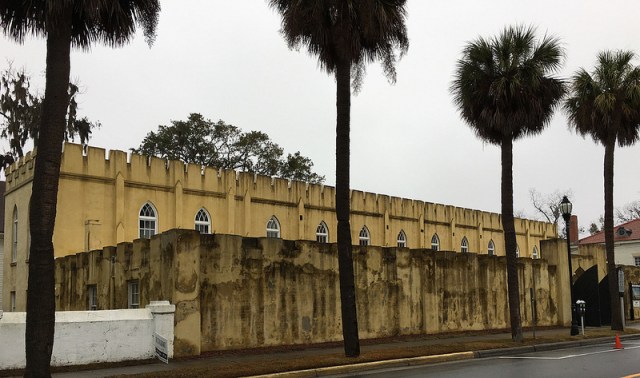
Beaufort Arsenal
The other spot I need to go see is the house of Robert Smalls. Smalls was born into slavery and was hired out to work in Charleston and learned to pilot ships. After the Civil War started, Smalls piloted a Confederate ship out into the harbor, knowing the locations of all the Confederate mines and forts, and sailed right to a Union ship waving a white flag from a mattress. The ship was taken as a prize, and Smalls became a hero to the Union. He continued to work for the Union navy around South Carolina, and eventually purchased the home of the family that owned him. He became active politically, and ran for Congress serving 5 terms, even after the protection of the federal military in Reconstruction. His home is in the historic area of Beaufort, and not currently open for tours (but it is apparently for sale.)
Penn Center
South Carolina had outlawed teaching slaves how to read or write and there was an immediate need to have schools set up for the freed population. Help came from northern states, with two women from Pennsylvania arriving to set up the Penn School. By 1864, the school had it’s own buildings on an island in the Beaufort area, with support from a church nearby that still serves congregants today. The Penn School story could have ended when President Andrew Johnson refused to continue the Port Royal experiment, but the teachers from the north stayed, teaching vocational skills and liberal arts to the community.
There’s much more to the Penn Center story, but the other notable part that is worth mentioning is that Martin Luther King Jr used the center with other civil rights leaders as a base of operations. Though it’s tough to know for certain, with King visiting the center so often, it’s claimed that early drafts of his I Have a Dream Speech were written there.
Visiting today is centered around learning about the Penn School and the activities after. The only original building in the area is the Brick Baptist Church which was built by slaves, and then taken over as the community church in 1861. The Penn Center visitor center and museum sells items printed in the Gullah language and cultural items from the area. The Park Service holds the title to Darrah Hall built in 1903, which is the oldest building on the campus today.
Port Royal
This site was a special treat, since the area is not usually open for the public to visit. The land that was formerly plantations that became part of the experiment is outside the city of Beaufort. Today, it’s mostly covered by a Naval Hospital, meaning it’s a restricted area, and there’s no chance to see it.
The anniversary events opened the gates to a site just outside the fence of the hospital, which surprisingly featured the remains of Fort Frederick, built by the British in 1730, and made of Tabby, sort of concrete made from shells. The site is preserved by South Carolina, and is usually gated, but it was opened up with rangers explaining the area. It wasn’t my goal to see the remains of the fort, but it was neat to walk around the walls of something almost 300 years old, and a reminder that geography shapes a lot of this history: crossroads and harbors are always important.
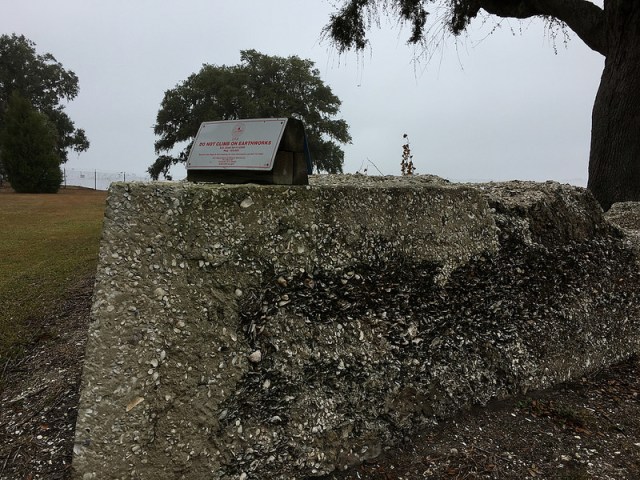
See the shells?
The site’s relevance to Reconstruction was just inside the fenced hospital grounds. In 1863, an elaborate ceremony was planned to announce the Emancipation Proclamation to the community of African Americans that had been working in the area. The proclamation had been announced by Lincoln in September, and it was to take effect January 1, 1863. General Rufus Saxton (great name), decided to make it an event, and also celebrate his recruiting efforts to organize a company of African American soldiers.
He ordered more molasses and tobacco brought in, and had hundreds of loaves of bread baked, and oxen roasted to feed a crowd. Over 5000 people showed up on January 1 for the ceremony.
The ceremony started with prayers, and and speeches, and then the reading of the Emancipation Proclamation. The colonel of the First South Carolina Volunteers, a regiment composed of escaped slaves, received a United States flag, and their regimental colors on stage. Just as the colonel was going to make his remarks,
an elderly freedman in the large audience surrounding the platform spontaneously broke into song, and was soon joined by most of the blacks around him, singing: “My country ’tis of thee, Sweet land of liberty, Of thee I sing!”
The stunned colonel and dignitaries sharing the platform listened as the blacks sang, and Higginson (the colonel), commented in his diary that night, “I never saw anything so electric; it made all other words cheap; it seemed the choked voice of a race at last unloosed… Just think of it! — The first day they have ever had a country, the first flag they have ever seen which promised anything to their people… the life of the whole day was in those unknown people’s song.” Colonel Higginson responded by saying any words he might speak would pale in comparison to what had just happened…
The colonel himself recorded in his diary at the end of the day, “So ended one of the most enthusiastic and happy gatherings I ever knew. The day was perfect, and there was nothing but success.” – Camp Saxton Site National Register Listing
I was able to get some pictures from far away of the historic marker that supposedly marks the tree that was at the center of the ceremony. I hadn’t fully comprehended the significance of the site when I arrived, I just knew I was able to go somewhere that wasn’t usually open. As I read more on site, I realized just what a tremendous occasion happened there. With that, I got into my car and continued on, wishing I had done a little more digging before I visited, but glad I did anyway.
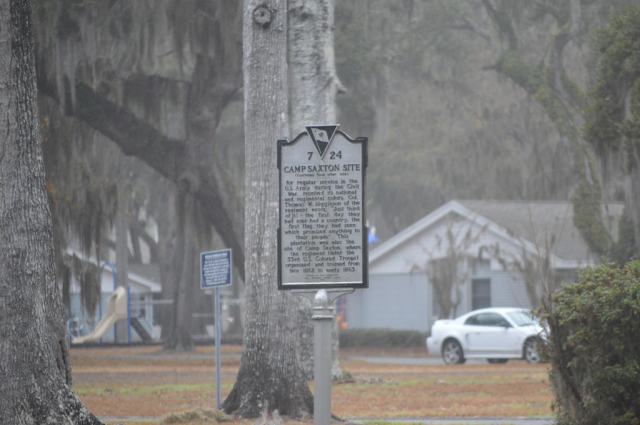
 An American Adventure